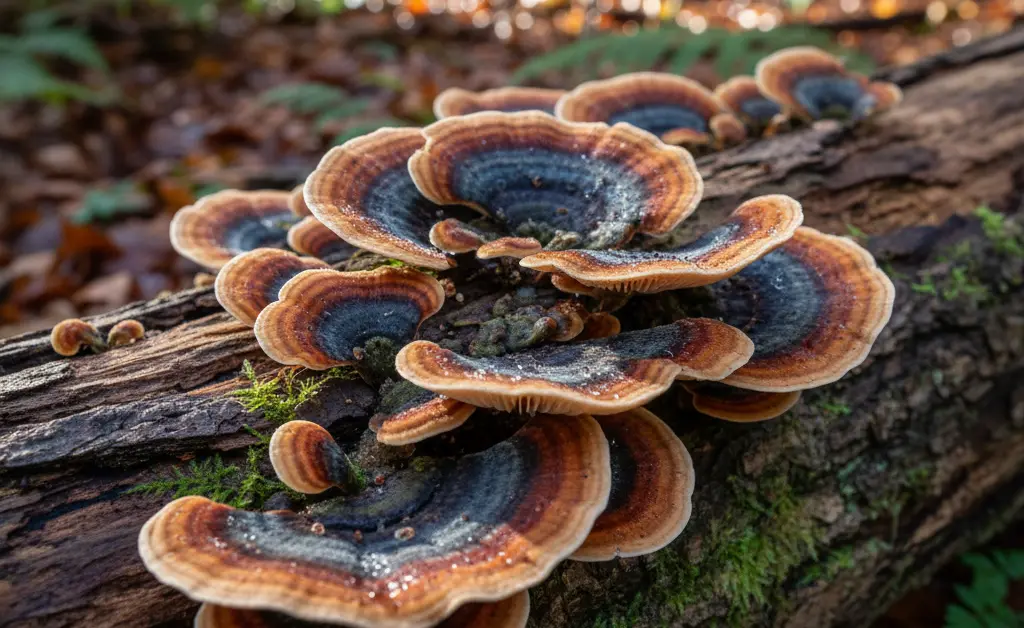
Turkey tail mushroom is widely recognized for its distinctive appearance and numerous potential benefits. Beyond its globally recognized common name, this fascinating and colorful fungus is known by a variety of appellations across different cultures and scientific disciplines. Understanding the turkey tail mushroom other names, including its popular designations and formal scientific classifications, is essential for accurate identification, research, and communication within the mycological community and among enthusiasts. This article aims to clarify the diverse terminology associated with Trametes versicolor, exploring both the common, descriptive labels people use in everyday language and the precise botanical synonyms that reflect its historical and current scientific understanding. By shedding light on these various names, we can better appreciate the rich linguistic and scientific landscape surrounding this remarkable organism.
Other Names for Turkey Tail Mushroom

Beyond its primary common designation, understanding the various turkey tail mushroom other names is crucial for enthusiasts and researchers alike. These alternate names often arise from cultural observations of its physical characteristics or traditional uses. While “turkey tail mushroom” is widely understood, exploring its aliases can provide deeper insight into how this fungus is perceived and discussed globally. Accurate identification of this polypore requires familiarity with these common designations.
Turkey Tail Fungus
Referring to it simply as “Turkey Tail Fungus” is a common and straightforward way to describe this organism. This nomenclature emphasizes its classification within the fungal kingdom and reinforces its distinctive appearance, which resembles the fanned tail of a turkey. While “mushroom” often implies a cap and stem structure, “fungus” broadly encompasses organisms like the turkey tail, which grows as a shelf-like or bracket fungus on wood. This general descriptive term is often used interchangeably with “mushroom” in many non-scientific contexts.
Many-zoned Polypore
The name “Many-zoned Polypore” is a highly descriptive common name that highlights two key characteristics of the turkey tail mushroom. “Polypore” refers to its classification as a type of fungus that releases spores through tiny pores on its underside, rather than gills. These pores are a distinguishing feature of the Trametes versicolor. The “many-zoned” aspect directly describes the vibrant, concentric bands of color that adorn its upper surface, creating a visual pattern akin to numerous distinct zones. This particular common name is favored by mycologists and foragers for its precision in describing the fungal structure and its signature banded appearance, aiding in turkey tail identification and distinguishing it from potential look-alikes like the False turkey tail, which might lack the clear pore surface or vibrant zonation.
Scientific Names and Synonyms of Turkey Tail Mushroom
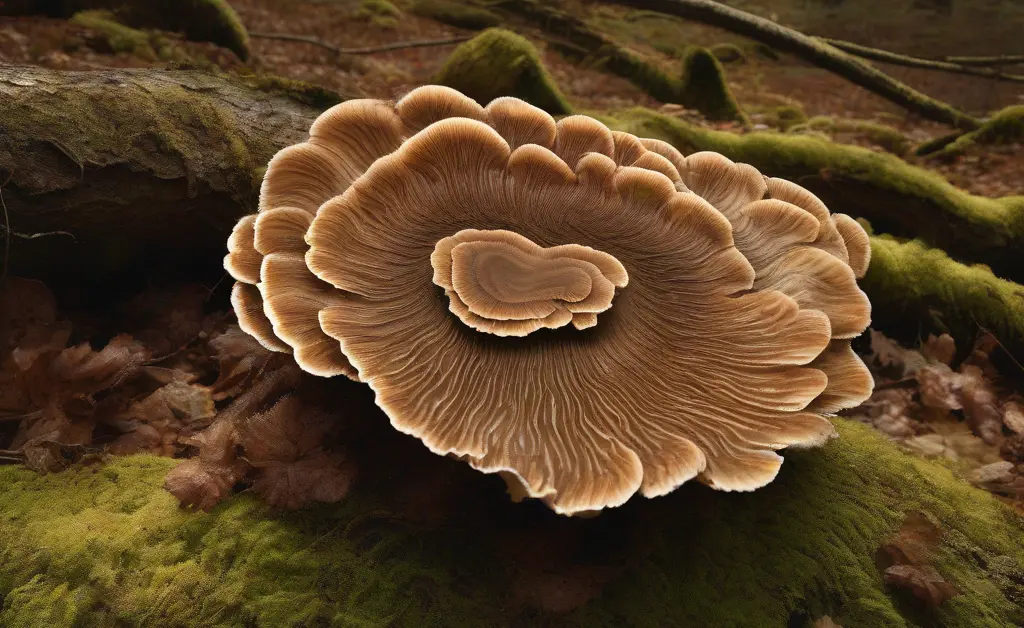
The scientific classification of organisms provides a universal language for clear and unambiguous communication, transcending regional common names. For the turkey tail mushroom, other names in the scientific realm include its current accepted designation and several historical synonyms that reflect the evolving understanding of fungal taxonomy. These scientific appellations are vital for research, accurate botanical documentation, and ensuring that discussions about the species refer to the correct organism, distinguishing it from any Turkey Tail poisonous look alike. For more detailed information on health and scientific research, resources from the NIH can be consulted.
Trametes versicolor (L.) C.G. Lloyd
This full scientific name represents the complete taxonomic journey of the turkey tail mushroom within the botanical world. The primary binomial, Trametes versicolor, denotes its genus and species. The parenthetical “(L.)” indicates that Carl Linnaeus originally described this species, albeit under a different genus. “C.G. Lloyd” refers to Curtis Gates Lloyd, the mycologist who later transferred the species to its current genus, Trametes. This detailed citation is standard in mycology and ensures proper attribution for its classification history.
Current Scientific Name: Trametes versicolor
The universally accepted and current scientific name for the turkey tail mushroom is Trametes versicolor. This binomial nomenclature is critical for scientific accuracy, enabling researchers, cultivators, and mycologists worldwide to refer to the exact same species, regardless of local common names. The genus Trametes is known for its tough, leathery, shelf-like polypores, and versicolor (Latin for “of various colors”) aptly describes the multicolored zones that are a hallmark of this particular species. Understanding this precise scientific name is fundamental for anyone engaging in serious study or discussion of this fungus, including the properties of the mycelium of the Trametes versicolor.
Historical Scientific Synonyms: Coriolus versicolor
Throughout the history of mycology, the classification of fungi has evolved as new research and techniques emerge. One significant historical scientific synonym for the turkey tail mushroom is Coriolus versicolor. For a period, this name was widely used, reflecting a different taxonomic grouping. The term “synonym” in this context refers to an earlier scientific name that is no longer considered current but still refers to the same biological species. Knowledge of this synonym is valuable for interpreting older scientific literature and understanding the historical trajectory of fungal classification. When encountering studies or texts referring to Coriolus versicolor, it is important to recognize that they are discussing the same fungus now known as Trametes versicolor.
Historical Scientific Synonyms: Polyporus versicolor
Another important historical scientific synonym for the turkey tail mushroom is Polyporus versicolor. This name was an even earlier classification, placing the species within the extensive genus Polyporus, a large group of pore fungi. As mycological understanding advanced, characteristics that differentiate Trametes from Polyporus became clearer, leading to the reclassification. The shift from Polyporus versicolor to Coriolus versicolor and ultimately to Trametes versicolor illustrates the dynamic nature of botanical and fungal taxonomy. Recognizing these historical aliases helps in navigating older scientific records and appreciating the ongoing efforts to refine the scientific classification of species, ensuring clarity in the nomenclature of this fascinating organism.
It is important to note that this content is not intended as medical advice. The information provided here is for general knowledge and informational purposes only, and does not address individual circumstances. It is not a substitute for professional medical advice, diagnosis, or treatment and should not be relied on to make decisions about your health. Always seek the advice of your physician or other qualified health provider with any questions you may have regarding a medical condition.
FAQ
— What are the common names for turkey tail mushroom?
Beyond its primary descriptor, turkey tail mushroom other names that are commonly used include cloud mushroom or sometimes even multiple color bracket fungus. These names highlight its distinctive visual characteristics, from its varied hues to its shelf-like growth pattern on wood.
— What is the scientific name of turkey tail mushroom?
The scientific name for turkey tail mushroom is Trametes versicolor. This binomial nomenclature helps scientists universally identify the species, distinguishing it clearly from other fungi across different regions and languages.
— Are there any alternate names for Trametes versicolor?
Yes, Trametes versicolor has been known by other scientific classifications throughout history. Notably, Coriolus versicolor is a widely recognized synonym that still appears in literature and discussions today, reflecting past changes in fungal taxonomy.
— Is Coriolus versicolor a synonym for turkey tail?
Indeed, Coriolus versicolor is recognized as a historical and commonly used synonym for the fungus now more precisely classified as Trametes versicolor. While the current accepted scientific name is Trametes versicolor, you will still encounter Coriolus versicolor in many traditional texts and studies when referring to this mushroom.