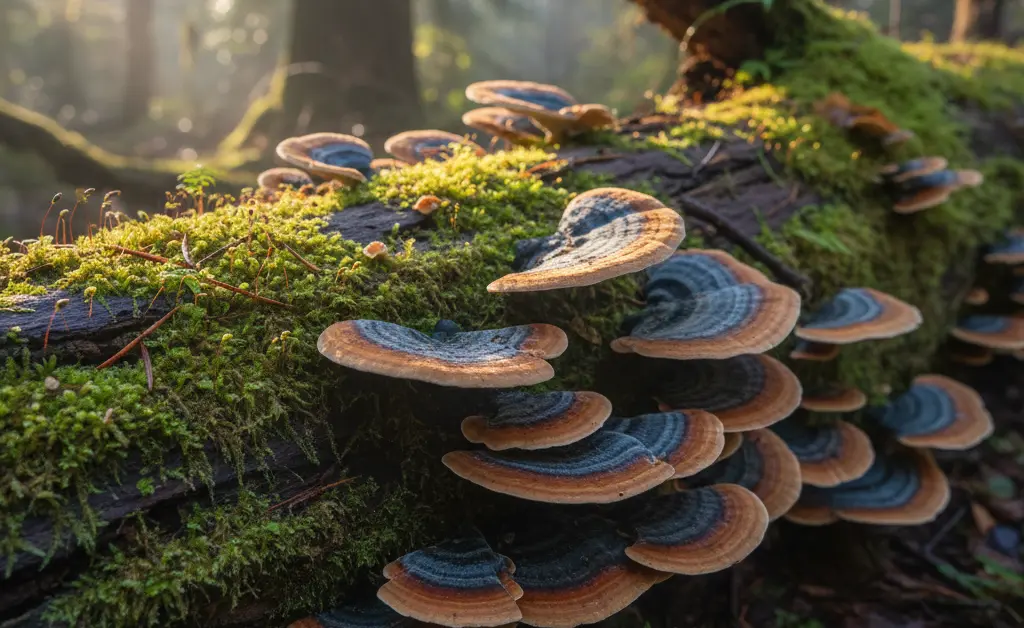
Picture a crisp morning walk through a local woodland, the air still damp from overnight rain. As you navigate the winding path, your eye catches a series of strikingly colored, fan-shaped fungi adorning a decaying log. Their distinct bands of earthy tones – grays, browns, and blues – create a natural tapestry, prompting a moment of contemplation about the forest’s hidden life. This common observation often leads to questions about identification and purpose. Among the myriad species encountered, the robust and ubiquitous trametes versicolor, also known as the Turkey Tail mushroom, stands out. This article aims to demystify this fascinating organism, providing a comprehensive guide to its identification, exploring its vital ecological role, and outlining its scientific classification. Understanding these characteristics allows for a deeper appreciation of its presence in natural environments.
Introduction to Trametes versicolor (Turkey Tail Mushroom)
Understanding the Turkey Tail (Trametes versicolor)
The Turkey Tail mushroom, scientifically known as trametes versicolor, is a ubiquitous polypore fungi found across temperate forests worldwide. Its common name, Turkey Tail, is derived from its appearance, which often resembles the fanned tail of a wild turkey, complete with concentric zones of varying colors. This beautiful and resilient mushroom is a significant component of forest ecosystems, playing a crucial role that extends beyond its striking visual appeal. Belonging to the class Basidiomycetes, it is a type of shelf fungus or bracket fungus, typically found growing in stacked layers on dead wood. Its prevalence and distinctive features make it a subject of considerable interest in mycology and natural history. Further scientific information and health-related research can often be found on platforms like NIH.
Identifying Features of Trametes versicolor (Turkey Tail Mushroom)
Cap Characteristics and Zonation
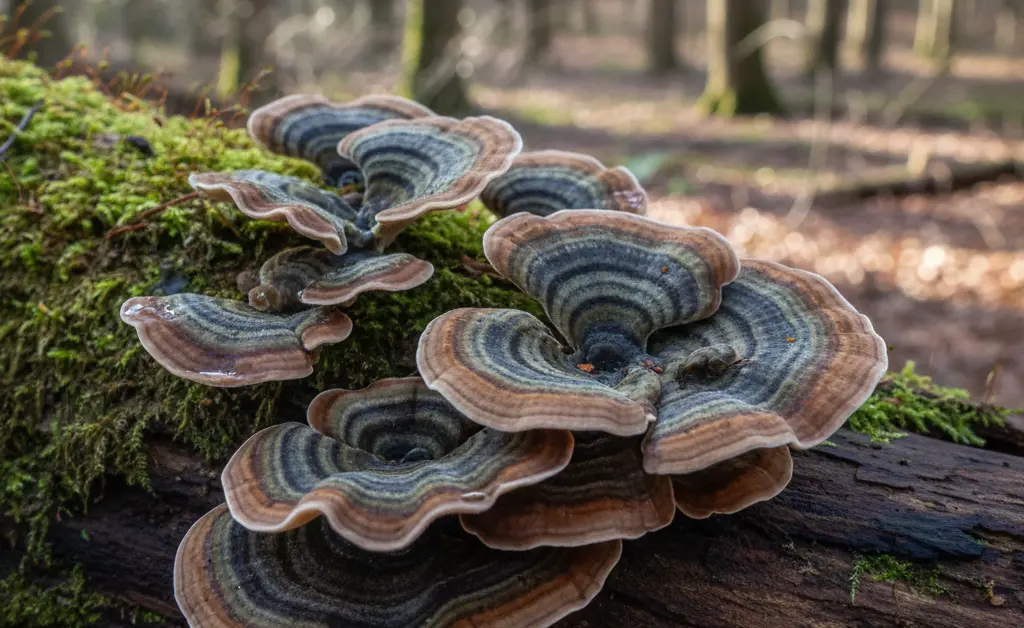
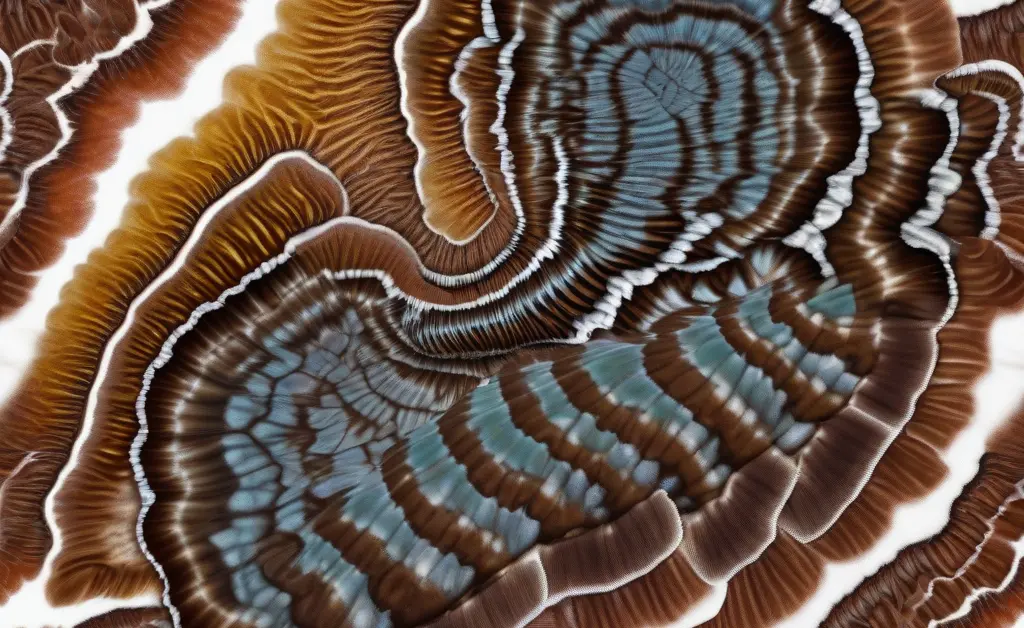
The cap of the Turkey Tail mushroom is perhaps its most distinguishing feature. It is typically thin, leathery, and fan-shaped or semicircular, often appearing in overlapping clusters. The surface is velvety or finely hairy, especially towards the margin. What truly sets the cap apart are its vibrant, concentric zones of color. These bands can exhibit a wide spectrum of hues, including browns, grays, blues, purples, greens, and even reds, often with a paler, sometimes whitish, outer edge. The precise color combination can vary significantly depending on environmental conditions, age, and geographical location, making each fruiting body a unique display of nature’s artistry. The zonate pattern is consistent, however, providing a reliable identification marker for trametes versicolor.
Pore Surface and Underside
Unlike gilled mushrooms, the Turkey Tail mushroom belongs to the polypore family, meaning it releases its spores from tiny pores on its underside rather than gills. The pore surface of authentic Turkey Tail is characteristically white or cream-colored, becoming slightly yellowish or brownish with age. These pores are exceptionally small and numerous, almost imperceptible to the naked eye without close inspection. A key identifier for trametes versicolor is the number of pores per millimeter; it typically has a very high pore density, often between 3 to 8 pores per millimeter. Running a finger across the pore surface will reveal a smooth, almost velvety texture, distinguishing it from other similar-looking fungi that might have larger, angular pores or gill-like structures.
Growth Patterns and Texture
Trametes versicolor exhibits characteristic growth patterns that aid in its identification. It typically grows in shelves or brackets, often forming dense, overlapping clusters on its substrate. These clusters can cover large sections of logs or stumps. The individual fruiting bodies are generally thin and flexible when fresh, becoming more rigid and brittle as they dry out. The texture of the cap’s upper surface is velvety or finely pubescent, a tactile sensation that complements its visual characteristics. The margins of the cap are often wavy or lobed, adding to its distinctive Turkey Tail appearance. This combination of growth habit, texture, and the unique cap zonation makes the identification of this common fungi relatively straightforward for the attentive observer.
Habitat and Ecological Role of Trametes versicolor
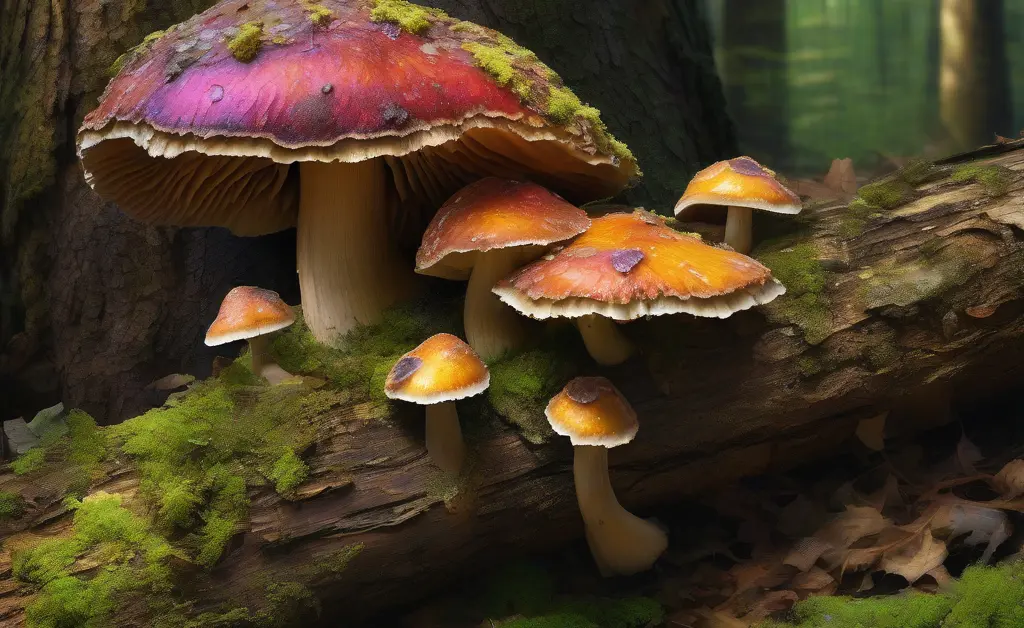
Trametes versicolor as a Lignicolous Fungus
Trametes versicolor is classified as a lignicolous fungus, meaning it grows on wood. More specifically, it is a saprobic fungi, which denotes its vital role as a decomposer. It thrives on dead or decaying hardwood, such as logs, fallen branches, and stumps, breaking down complex woody materials. This process of decomposition is critical for nutrient cycling in forest ecosystems. By breaking down lignin and cellulose, the primary components of wood, trametes versicolor releases essential nutrients back into the soil, making them available for other plants and organisms. Without such decomposers, forests would accumulate vast amounts of dead wood, hindering new growth and overall ecosystem health.
Preferred Substrates (Wood Types)
While trametes versicolor can occasionally be found on conifers, its strong preference is for deciduous hardwoods. Common substrates include oak, maple, birch, beech, and cherry logs and stumps. This preference for hardwoods is linked to its enzymatic capabilities, which are particularly effective at breaking down the specific types of lignin and cellulose found in these tree species. The presence of ample dead hardwood in a forest is often a good indicator of where one might find abundant Turkey Tail fungi. Its ability to colonize and efficiently decompose a wide variety of hardwood types contributes to its widespread distribution and ecological significance.
Geographical Distribution and Abundance
The Turkey Tail fungus boasts an impressive geographical distribution, making it one of the most common and recognizable bracket fungi worldwide. It is abundant in temperate forests across North America, Europe, and Asia, and can also be found in various other regions globally where suitable hardwood substrates are present. Its adaptability to different climatic conditions and its efficient spore dispersal mechanisms contribute to its pervasive presence. In many forest ecosystems, it is not uncommon to encounter this colorful polypore on almost any walk, highlighting its integral and frequent role in the natural cycle of decomposition. This widespread abundance underscores its importance as a key decomposer in many of the world’s forests.
Common Name, Scientific Classification, and Taxonomy of Trametes versicolor
Common Names and Taxonomy
The mushroom known as trametes versicolor has garnered several common names throughout history, reflecting its distinctive appearance and widespread recognition. The most prevalent common name is “Turkey Tail,” which perfectly describes its fan-shaped, multi-colored bands reminiscent of a turkey’s fanned plumage. Other less common names include “many-zoned polypore” and “cloud mushroom.”
From a scientific standpoint, its taxonomy is as follows:
- Kingdom: Fungi
- Phylum: Basidiomycota
- Class: Agaricomycetes
- Order: Polyporales
- Family: Polyporaceae
- Genus: Trametes
- Species: Trametes versicolor
Historically, this species was also known by the scientific name Coriolus versicolor, and this name is still occasionally encountered in some older literature. However, the current accepted scientific name within the field of mycology is Trametes versicolor. This classification places it firmly within the group of wood-rotting fungi, underscoring its ecological function as a decomposer.
It is important to note that this content is not intended as medical advice. This article provides general information for educational purposes only and should not be used as a substitute for professional medical guidance. Always consult with a qualified healthcare provider before making any decisions related to your health or well-being. The information presented here is not intended to diagnose, treat, cure, or prevent any disease.
FAQ
— What is Trametes versicolor commonly known as?
*Trametes versicolor* is widely recognized by its common name, Turkey Tail mushroom. This name comes from its striking appearance, featuring concentric rings of different colors that often resemble the fanned tail feathers of a turkey. Its vibrant, zoned patterns make it easily identifiable in natural settings.
— Where does Trametes versicolor grow?
Turkey Tail mushrooms are ubiquitous across deciduous and coniferous forests worldwide. They predominantly grow on decaying hardwood logs, stumps, and fallen branches, acting as a natural decomposer. This species thrives in damp, shaded environments, often appearing in impressive clusters.
— How do you identify Turkey Tail mushrooms?
Identifying Turkey Tail involves observing its distinct features: a thin, leathery, fan-shaped cap with multiple concentric zones of varying colors. The upper surface often has a velvety or fuzzy texture, while the crucial distinguishing characteristic is the underside, which displays tiny, white, visible pores rather than gills. These pores help differentiate it from many look-alike species.
— Is Trametes versicolor a common mushroom?
Yes, the Turkey Tail mushroom is exceptionally common and one of the most widespread fungi found globally. It frequently appears in woodlands throughout North America, Europe, and Asia. Its adaptability to various forest types contributes to its pervasive presence, making it a familiar sight for foragers and hikers alike.