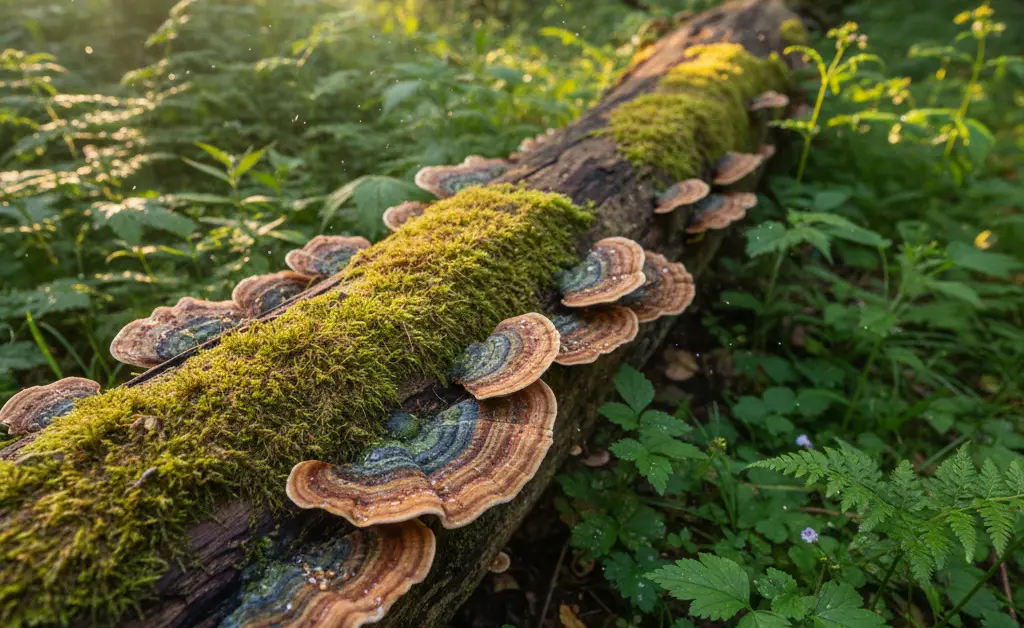
Known for its distinctive fan-shaped fruiting bodies resembling a turkey’s tail, this common woodland fungus is widely recognized for its vibrant concentric rings and its significant role in ecosystems. Beyond its visual appeal, it has garnered considerable attention in wellness communities, often dried and used in teas or supplements. This fascinating organism, formally identified as trametes versicolor, plays a crucial part in nature’s decomposition processes, breaking down deadwood and recycling nutrients back into the soil. Understanding its unique characteristics, growth patterns, and ecological functions is essential for both mycology enthusiasts and those interested in its broader environmental impact. This article delves into the scientific aspects of its identification and its vital niche within various habitats.
Introduction to Trametes versicolor (Turkey Tail Mushroom)
Understanding the Turkey Tail (Trametes versicolor)
The Turkey Tail mushroom, scientifically known as trametes versicolor, is a ubiquitous fungi species found across temperate forests worldwide. Its name is derived from its appearance, which often mimics the variegated feathers of a turkey’s tail, characterized by striking concentric bands of color. This organism is highly valued not only for its aesthetic appeal but also for its profound ecological significance as a decomposer. Researchers and enthusiasts alike study its distinct features, understanding its life cycle and its integral role in maintaining forest health. Interest in this particular polypore extends to its potential associations with traditional wellness practices, where it has been explored for its natural compounds. Further research into the safety and efficacy of such compounds is often reviewed by bodies like the EFSA.
Common Name, Scientific Classification, and Taxonomy of Trametes versicolor
Common Names and Taxonomy
While formally recognized as trametes versicolor, this fungi is most widely known by its evocative common name, Turkey Tail. Other regional names like “Coriolus versicolor” have also been used, reflecting historical taxonomic classifications. Within the scientific community, it belongs to the kingdom Fungi, phylum Basidiomycota, class Agaricomycetes, order Polyporales, and family Polyporaceae. This classification places it firmly within the group of shelf fungi or bracket fungi, characterized by their tough, woody texture and the presence of pores on their underside rather than gills. Its taxonomic journey highlights a rich history of scientific study focused on understanding its unique biological attributes and its place within the intricate fungal kingdom.
Identifying Features of Trametes versicolor (Turkey Tail Mushroom)
Cap Characteristics and Zonation
The cap of the Turkey Tail mushroom is perhaps its most striking feature, crucial for proper identification. It typically grows in a fan or semicircular shape, often thin and flexible when fresh, becoming more rigid with age. A key identifying characteristic is the presence of distinct concentric zones of varying colors. These bands can range from shades of brown, gray, and tan to more vibrant hues of blue, green, or red, especially when moist. The surface of the cap is usually velvety or finely hairy, giving it a soft texture, which can be felt upon touch. The margin or edge of the cap is often thin, wavy, and lobed, contributing to its intricate appearance.
Pore Surface and Underside
Turning the mushroom over reveals another critical identification mark: its pore surface. Unlike gilled mushrooms, trametes versicolor is a polypore, meaning its underside is covered in countless tiny, visible pores. These pores are typically white or cream-colored, appearing smooth to the naked eye but revealing their porous nature under magnification. The absence of gills is a definitive characteristic separating it from many other fungi species. The pore surface should be free of significant teeth or spines, further confirming its identity as a true Turkey Tail. When pressed gently, the pore surface usually does not bruise or change color significantly.
Growth Patterns and Texture
Trametes versicolor typically grows in overlapping clusters or rosette formations, forming shelves or brackets on its substrate. These clusters can be quite extensive, often covering significant portions of dead logs or stumps. The overall texture of the fruiting body is leathery and tough, but still somewhat pliable when young and fresh. As the mushroom matures, it becomes more rigid and woody. Its growth habit, often in layers or tiers, along with its characteristic texture and vibrant zonation, makes it relatively easy to distinguish from other similar-looking fungi. The presence of these consistent growth patterns helps confirm the identity of this common bracket fungus.
Habitat and Ecological Role of Trametes versicolor
Trametes versicolor as a Lignicolous Fungus
Trametes versicolor is classified as a lignicolous fungus, meaning it grows on wood. More specifically, it is a saprobic organism, playing a vital role as a decomposer in forest ecosystems. It is a particularly effective white rot fungus, which means it possesses the enzymatic machinery to break down both cellulose and lignin, the complex polymers that give wood its structural rigidity. Through this process, trametes versicolor facilitates the decay of dead trees and woody debris, returning essential nutrients to the soil and contributing to the overall nutrient cycling within its environment. This decomposition is crucial for forest health, preventing the accumulation of dead wood and supporting new growth.
Preferred Substrates (Wood Types)
The Turkey Tail fungus exhibits a strong preference for hardwood substrates. It is most commonly found growing on fallen logs, stumps, and dead branches of deciduous trees. Common host trees include oak, maple, birch, cherry, and beech. While it occasionally appears on coniferous wood, its prevalence and vigor are significantly higher on hardwoods. The decaying wood provides the necessary nutrients and moisture for the mycelium of trametes versicolor to thrive, allowing it to produce its characteristic fruiting bodies. This preference for specific wood types helps in identifying its presence in various forest settings.
Geographical Distribution and Abundance
Trametes versicolor is one of the most widespread fungi species globally, found in nearly every continent where suitable woody habitats exist. It is particularly abundant in temperate forests across North America, Europe, and Asia. Its adaptability to a wide range of environmental conditions, coupled with its ability to colonize various hardwood species, contributes to its high abundance. This ubiquitous presence makes the Turkey Tail a common sight for hikers, foragers, and mycologists alike, easily spotted throughout the year, especially in damp conditions. Its global distribution underscores its ecological importance and its robust nature as a saprobic decomposer.
In conclusion, trametes versicolor, widely known as the Turkey Tail mushroom, is a truly remarkable organism with a significant presence in our natural world. Its distinct fan-shaped caps, vibrant concentric coloration, and pore-covered underside make it readily identifiable for mycology enthusiasts. Beyond its visual appeal, its ecological role as a lignicolous, white rot fungus is paramount, diligently breaking down dead hardwoods and enriching forest ecosystems. This widespread decomposer, found abundantly across temperate regions, underscores the intricate balance of nature and the vital contributions of even the smallest organisms to the health of our planet.
The content presented here is not a substitute for professional medical guidance. This article is intended for informational purposes only and does not provide medical advice, diagnosis, or treatment. Always consult with a qualified healthcare professional before making any decisions related to your health or incorporating new supplements into your regimen. Individual responses to dietary or herbal supplements can vary, and it is crucial to ensure that any health-related choices are appropriate for your specific circumstances.
FAQ
— What is Trametes versicolor commonly known as?
The mushroom known scientifically as trametes versicolor is commonly recognized as Turkey Tail. This name reflects its distinctive fan-like shape and concentric rings of varying colors, which often resemble the fanned tail feathers of a wild turkey. It is one of the most well-known functional mushrooms across the globe.
— Where does Trametes versicolor grow?
This resilient fungus thrives on dead hardwood logs and branches in forests worldwide. It acts as a significant decomposer, breaking down woody material and returning nutrients to the ecosystem. You can often spot it growing in clusters or overlapping tiers on fallen trees and stumps.
— How do you identify Turkey Tail mushrooms?
Identifying Turkey Tail involves observing its striking appearance: thin, leathery, and fan-shaped caps with distinct velvety zones of various colors like brown, gray, blue, and reddish-brown. Its underside is crucial for identification, featuring tiny pores instead of gills, giving it a smooth or finely textured feel. The vibrant, concentric bands are a key characteristic that sets it apart.
— Is Trametes versicolor a common mushroom?
Yes, this mushroom is indeed very common and widely distributed across continents. It grows prolifically in various temperate forests, making it one of the most frequently encountered fungi. Its adaptability and role as a saprobic species contribute to its widespread presence in natural environments.