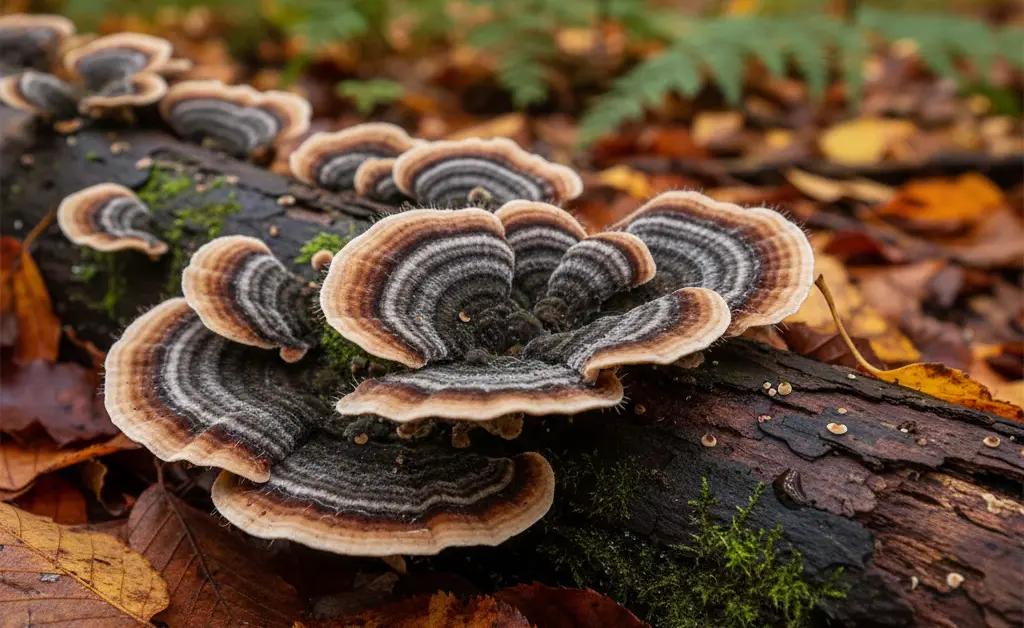
On a crisp autumn morning, a walk through the local woods often reveals nature’s intricate artistry. One particular discovery, nestled on a fallen log, might catch the eye: a shelf-like fungus with vibrant, concentric bands of color. This wasn’t just any mushroom; its striking appearance hinted at a deeper story within the forest ecosystem. For many, such an encounter sparks curiosity, prompting a desire to understand the life forms that contribute to the forest’s health and biodiversity. This guide delves into the precise identification and ecological significance of trametes versicolor, commonly known as Turkey Tail, exploring its distinct features, preferred habitats, and vital role in decomposition, offering a scientific lens to appreciate this widespread and fascinating organism.
Understanding the Turkey Tail (Trametes versicolor)
The Turkey Tail mushroom, scientifically known as Trametes versicolor, is a common and widely recognized bracket fungus found across diverse temperate forests globally. Its striking appearance, characterized by colorful concentric zones resembling a turkey’s tail feathers, makes it easily identifiable to even a casual observer. As a saprobic fungus, it plays a critical role in the decomposition of dead wood, cycling nutrients back into the forest ecosystem. Its presence often signifies a healthy woodland environment where natural decay processes are actively occurring.
Common Name, Scientific Classification, and Taxonomy of Trametes versicolor
Common Names and Taxonomy
Trametes versicolor is most widely known by its common name, Turkey Tail. This descriptive moniker directly references its fan-shaped, multi-colored appearance. Other regional names may include many-zoned polypore or cloud mushroom. From a scientific standpoint, Trametes versicolor belongs to the kingdom Fungi, phylum Basidiomycota, class Agaricomycetes, order Polyporales, and family Polyporaceae. This classification places it among the polypores, a group of fungi known for their tough, woody, or leathery fruiting bodies and pore-like undersurfaces. The genus Trametes encompasses various white-rot fungi, with versicolor meaning “of various colors,” aptly describing this particular species. For detailed scientific literature on fungal taxonomy, resources like PubMed are invaluable.
Identifying Features of Trametes versicolor (Turkey Tail Mushroom)
Accurate identification of Trametes versicolor is crucial for mycologists and enthusiasts alike. While its general appearance is distinctive, paying attention to specific morphological features helps differentiate it from look-alike species. The common Turkey Tail fungus exhibits several key characteristics that aid in its reliable identification, making it one of the more recognizable fungi in the forest.
Cap Characteristics and Zonation
The cap of Trametes versicolor is typically fan-shaped, semicircular, or rosette-like, growing in overlapping layers or shelves. It measures approximately 2-8 cm across and 1-3 mm thick. The most striking feature is its vibrant zonation, displaying concentric bands of various colors such as brown, grey, rust, black, blue, green, and white. These zones often have different textures, ranging from velvety and finely hairy near the attachment point to smoother towards the margin. The margin itself is usually thin, wavy, and lighter in color, sometimes appearing slightly lobed.
Pore Surface and Underside
Unlike gilled mushrooms, Trametes versicolor possesses a pore surface on its underside. This surface is typically white to off-white or yellowish, becoming slightly brownish with age or handling. The pores are very small, numbering about 3-8 per millimeter, making them almost invisible to the naked eye without magnification. The pore surface should be smooth and even, and when gently bruised, it may show a slight discoloration. A key identifier is the absence of gills or teeth; the underside is exclusively made up of these tiny pores, which are characteristic of a true polypore.
Growth Patterns and Texture
Turkey Tail mushrooms generally grow in dense, overlapping clusters or rows on dead wood. Their fruiting bodies are thin and leathery, making them pliable when fresh but rigid and brittle when dry. The texture of the cap varies across its zones, from a fine velvety or pubescent feel near the base to smoother, often shiny, areas towards the edge. The attachment to the substrate is typically sessile, meaning it grows directly from the wood without a stalk. This shelf-like growth, combined with its unique texture and zonate coloring, solidifies the identification of Trametes versicolor.
Habitat and Ecological Role of Trametes versicolor
The ecological role of Trametes versicolor in forest ecosystems is profound, primarily centered around its function as a decomposer. This ubiquitous fungus plays a vital part in breaking down woody debris, thereby facilitating nutrient cycling and maintaining forest health. Understanding its preferred habitat and distribution helps to appreciate the widespread impact of this remarkable organism.
Trametes versicolor as a Lignicolous Fungus
Trametes versicolor is classified as a lignicolous fungus, meaning it grows on wood. More specifically, it is a white-rot fungus. White-rot fungi are distinct in their ability to degrade both cellulose and lignin, the complex polymers that give wood its rigidity. By breaking down lignin, Trametes versicolor creates characteristic white, stringy pockets of decayed wood, enriching the soil with organic matter and making nutrients available for other organisms. This saprobic activity is fundamental to the health and sustainability of woodlands and forests worldwide.
Preferred Substrates (Wood Types)
While Trametes versicolor can occasionally be found on coniferous trees, it shows a strong preference for hardwood trees (deciduous trees). Common substrates include fallen logs, stumps, and dead branches of oak, maple, birch, beech, and cherry trees. It thrives in environments where there is an abundance of dead or dying deciduous wood, providing it with a steady source of lignin and cellulose to decompose. This adaptability to various hardwood types contributes to its widespread presence across temperate regions.
Geographical Distribution and Abundance
Trametes versicolor is one of the most common bracket fungi globally, exhibiting a cosmopolitan distribution. It can be found in nearly every continent, thriving in temperate and subtropical forests. It is particularly abundant in North America, Europe, and Asia. Its resilience and capacity to colonize various types of dead hardwood substrates contribute to its high abundance. Whether in urban parks, suburban woodlands, or vast natural forests, the Turkey Tail mushroom is a frequent and familiar sight, consistently performing its essential role as a primary decomposer in its respective forest ecosystems.
The world of fungi is rich with both beauty and purpose, and Trametes versicolor stands out as a prime example of nature’s efficient recycling system. Its distinct visual characteristics, ranging from its vibrant, zonate cap to its tiny pore surface, make it a fascinating subject for identification. Beyond its aesthetics, its crucial role as a white-rot decomposer of hardwood ensures the continuous regeneration and health of forest ecosystems. From its taxonomic classification as a common polypore to its global distribution, the Turkey Tail mushroom embodies a vital ecological function, offering a glimpse into the intricate balance of the natural world.
The content presented here is not a substitute for professional medical guidance. It is for informational purposes only and should not be used to diagnose, treat, cure, or prevent any disease or health condition. Always consult with a qualified healthcare professional before making any decisions about your health or treatment. Individual results may vary.
FAQ
— What is Trametes versicolor commonly known as?
Trametes versicolor is widely recognized by its vibrant common name, Turkey Tail. This name arises from its striking fan-shaped appearance and concentric rings of different colors, which often resemble the fanned tail feathers of a wild turkey.
— Where does Trametes versicolor grow?
This robust functional mushroom thrives globally, commonly found in temperate forests across various continents. It primarily grows on dead or decaying hardwood logs, stumps, and branches, acting as a crucial decomposer in forest ecosystems.
— How do you identify Turkey Tail mushrooms?
Identifying Turkey Tail involves observing its distinctive fan or shelf-like shape, often growing in overlapping clusters. Look for its velvety texture on the upper surface and vibrant concentric zones of color, ranging from browns, grays, and blues to reds, contrasting with a white or off-white pore surface on the underside.
— Is Trametes versicolor a common mushroom?
Indeed, the Turkey Tail mushroom is one of the most widespread and easily identifiable functional fungi in the world. Its prolific growth on dead wood makes it a very common sight in woodlands and forests across many regions.