
In today’s fast-paced world, many individuals are increasingly seeking natural ways to support their well-being, often turning to superfoods and botanical supplements. Among these, certain fungi have garnered significant attention for their potential health benefits, integrating seamlessly into daily wellness routines. One such organism, widely recognized for its distinctive appearance and rich history in traditional practices, is the mushroom known scientifically as trametes versicolor. This fascinating polypore, commonly referred to as Turkey Tail, offers a compelling study not only for its contemporary applications in health but also for its remarkable ecological role. Understanding its precise identification and the specific environmental niches it occupies is crucial for anyone interested in mycology or natural health. This article delves into the science behind this ubiquitous fungus, exploring its defining characteristics and the critical function it plays within forest ecosystems.
Introduction to Trametes versicolor (Turkey Tail Mushroom)
The fungus known as trametes versicolor, more commonly recognized as Turkey Tail mushroom, is a visually striking and ecologically significant member of the fungal kingdom. This species stands out for its vibrant, concentric rings of color resembling the tail feathers of a wild turkey, hence its popular moniker. As a widespread polypore, it has been a subject of interest in mycology and traditional wellness practices across various cultures for centuries. The safety and efficacy of natural supplements are often assessed by regulatory bodies such as EFSA in Europe. Understanding the fundamental nature of this mushroom provides a foundation for appreciating its role both in nature and in human contexts.
Understanding the Turkey Tail (Trametes versicolor)
Turkey Tail, or Trametes versicolor, is a type of bracket fungus belonging to the group of basidiomycetes. It is characterized by its thin, leathery fruiting bodies that grow in overlapping layers or shelves on decaying wood. Unlike gilled mushrooms, this polypore releases its spores through tiny pores on its underside. Its robust presence in various ecosystems underscores its importance as a natural decomposer. Mycologists study this mushroom not only for its distinct physical attributes but also for its complex biological processes and interactions within forest ecosystems.
Identifying Features of Trametes versicolor (Turkey Tail Mushroom)
Accurate identification of Trametes versicolor is important for both mycology enthusiasts and those interested in its traditional uses. While many bracket fungi share superficial similarities, Turkey Tail possesses several distinct characteristics that set it apart. Paying close attention to the cap’s appearance, the pore surface, and its growth patterns is key to confirming its identity in the wild.
Cap Characteristics and Zonation
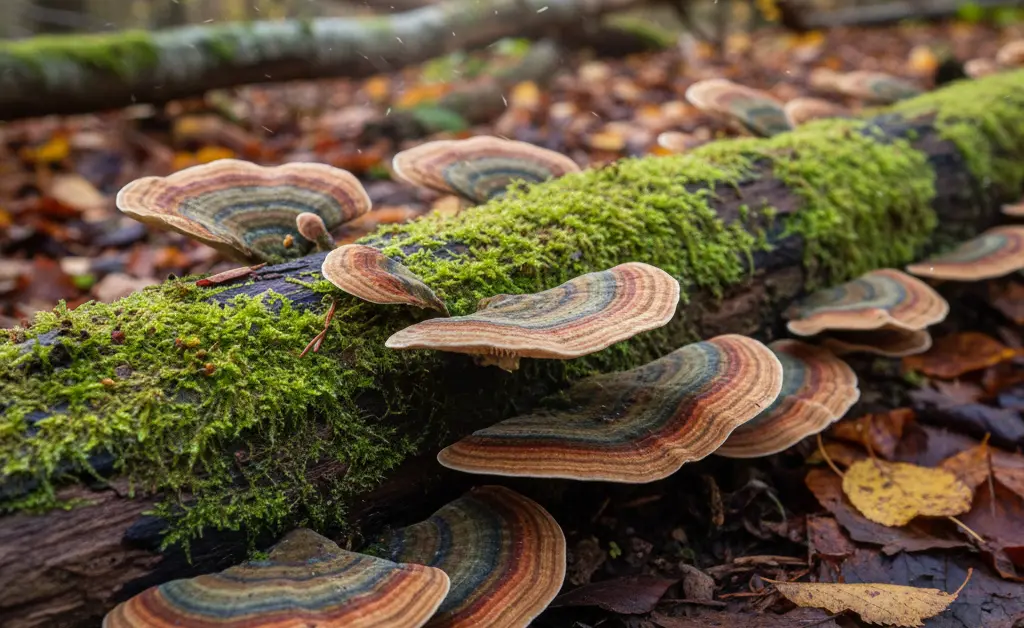
The cap of the Turkey Tail mushroom is perhaps its most recognizable feature. It typically grows in a fan or semicircular shape, often appearing thin and leathery. What makes it truly distinctive are the numerous concentric zones of varying colors. These zones can range from earthy browns and grays to vibrant blues, purples, greens, and reds, often displaying a velvety texture near the margin. The edges of the cap are usually wavy or lobed, adding to its decorative appearance and enhancing its resemblance to a turkey’s tail.
Pore Surface and Underside
Turning the mushroom over reveals another critical identification feature: the pore surface. Trametes versicolor is a true polypore, meaning it has a white or cream-colored underside covered in tiny, barely visible pores. These pores are extremely small, typically 3-8 pores per millimeter, giving the surface a smooth, almost velvety appearance when viewed closely. The absence of gills or teeth distinguishes it from many other fungi, and its pale pore surface helps differentiate it from species like Stereum ostrea, which has a smooth, gill-less underside without pores.
Growth Patterns and Texture
Turkey Tail fungus typically grows in a layered, overlapping fashion, forming shelves or rosettes on its substrate. Multiple fruiting bodies often emerge in close proximity, creating a cascading effect. The texture of the cap varies from velvety or finely hairy to somewhat rough, especially towards the center. Despite its delicate appearance, the fruiting body is tough and leathery, not easily broken. This resilient texture is characteristic of many shelf fungi, enabling them to persist on wood for extended periods.
Habitat and Ecological Role of Trametes versicolor
The ecological significance of Trametes versicolor is immense, particularly within forest ecosystems. It is a highly adaptable and ubiquitous fungus, playing a critical role in nutrient cycling and decomposition. Understanding its preferred habitat and function sheds light on the broader processes of nature and the interconnectedness of life.
Trametes versicolor as a Lignicolous Fungus
Trametes versicolor is classified as a lignicolous fungus, meaning it primarily grows on wood. More specifically, it is a saprobic organism, deriving its nutrients from dead and decaying organic matter. As a wood-rotting fungus, it is an essential decomposer in forests, breaking down complex lignin and cellulose found in wood. This process returns vital nutrients to the soil, making them available for other plants and organisms. Its presence indicates a healthy forest ecosystem actively recycling its resources.
Preferred Substrates (Wood Types)
While Trametes versicolor can be found on various types of wood, it shows a strong preference for hardwood trees. Common substrates include fallen logs, stumps, and dead branches of deciduous trees such as oak, maple, birch, and cherry. It can also sometimes be found on conifers, but this is less common. The fungus plays a vital role in breaking down these woody structures, contributing to the carbon cycle and maintaining forest health. Its ability to grow on diverse hardwood logs and stumps makes it a frequently encountered species for mycologists and hikers alike.
Geographical Distribution and Abundance
The Turkey Tail mushroom is one of the most widely distributed fungi globally. It can be found on every continent except Antarctica, thriving in temperate and tropical forest regions. In North America, it is particularly common, readily observed in virtually any woodland environment where dead wood is present. Its abundance and adaptability to various climates and hardwood species contribute to its widespread recognition. Its ubiquitous nature makes it an easily accessible subject for study in mycology and a familiar sight for those exploring forests.
Common Name, Scientific Classification, and Taxonomy of Trametes versicolor
The nomenclature surrounding Trametes versicolor reflects both its common recognition and its place within the scientific hierarchy. Understanding its common names and formal taxonomy helps in clear communication about this fascinating organism, highlighting its historical and biological identity.
Common Names and Taxonomy
The most widely recognized common name for Trametes versicolor is “Turkey Tail mushroom,” a descriptor inspired by the colorful, fan-shaped fruiting bodies that often resemble the fanned tail of a wild turkey. Other historical or regional common names include “cloud mushroom” and “rainbow bracket.” Scientifically, its classification places it within the kingdom Fungi, phylum Basidiomycota, class Agaricomycetes, order Polyporales, and family Polyporaceae. The genus Trametes comprises several species of bracket fungi, and versicolor specifically refers to its “various colors.” It was formerly known as Coriolus versicolor, a name still occasionally encountered in literature, though Trametes versicolor is the currently accepted scientific designation. This taxonomic journey underscores its identity as a true polypore and a significant member of the fungal kingdom.
In conclusion, the Turkey Tail mushroom, or Trametes versicolor, is a remarkable organism with a dual identity: a visually appealing fungus recognized for its distinct appearance and a vital contributor to forest ecosystems. Its identification hinges on specific features such as its concentric, multi-colored cap zones, tiny pore surface, and characteristic growth on decaying hardwood. Ecologically, it serves as a crucial saprobic decomposer, recycling nutrients and maintaining the health of woodlands worldwide. From its widespread distribution to its scientific classification, understanding this ubiquitous fungus enriches our appreciation for the intricate web of life and the silent, yet profound, work performed by organisms in our natural environments.
Readers should understand that this article does not offer medical diagnosis or treatment. This information is intended for educational purposes only and should not replace professional medical advice. Always consult with a qualified healthcare provider before making any decisions related to your health or incorporating new supplements into your regimen. Individual results may vary, and this content is not a substitute for personalized guidance.
FAQ
— What is Trametes versicolor commonly known as?
*Trametes versicolor* is most widely recognized as Turkey Tail due to its strikingly colorful, fan-shaped fruiting bodies that resemble a turkey’s fanned tail feathers. This vibrant, layered appearance makes it quite distinct in natural settings.
— Where does Trametes versicolor grow?
This mushroom is a widespread saprophytic fungus, meaning it primarily grows on dead or decaying hardwood logs and stumps. You can find it in forests across temperate regions globally, often appearing in shelf-like clusters on fallen timber.
— How do you identify Turkey Tail mushrooms?
Turkey Tail mushrooms are typically identified by their thin, leathery, semicircular caps that grow in overlapping layers. They display concentric rings of varying colors, often including shades of brown, gray, blue, and red, with a velvety or finely hairy top surface and a white pore surface on the underside.
— Is Trametes versicolor a common mushroom?
Yes, Turkey Tail is considered one of the most common bracket fungi found worldwide. Its adaptability allows it to thrive in diverse forest ecosystems, making it a frequently encountered sight for those exploring wooded areas.







